How to Quote Paving Installation: Nail Your Numbers Every Time
Learn how to quote paving installation accurately, from base prep to finishing touches. Get your pricing right to win jobs and keep your margins healthy.
Quick answer
Paving installation in Australia is quoted per square metre: standard concrete pavers cost $25-$50/m², clay brick $40-$70/m², and natural stone $70-$150+/m², before labour. Allow 1.5-3 hours per square metre for laying and jointing, plus 100-150mm of compacted road base at $30-$50 a tonne. Build in a 10-15% contingency for ground conditions or weather delays.
Why Paving Quotes Go Pear-Shaped: Getting Your Numbers Right
Paving jobs can quickly chew through profit if your quote isn't spot on. The biggest traps are underestimating site prep, materials, and labour for unexpected issues. To correctly quote paving installation, you need to break down every single cost, not just the per square metre price. Many tradies lose money by simply guessing the overall paving cost per m2 without accounting for access, ground conditions, or specific paver types. Getting the numbers right from the start means you cover your costs and make a fair margin, setting you up for a smooth job and happy customer. A detailed quote protects both you and your client from surprises, ensuring a clear path from start to finish. Without a solid process for how to quote paving installation, you're leaving money on the table or risking unhappy customers. Always factor in potential delays and unforeseen complications, typically an extra 10-15% buffer.
Breaking Down Paving Costs: What Influences the Price?
The final price tag on a paving job isn't just about the pavers themselves; several factors massively influence the overall paving cost per m2. Site accessibility is a big one: if you can't get machinery in easily, it means more manual labour and time. The existing ground conditions are critical – rocky ground, poor drainage, or uneven surfaces all require more extensive excavation and base preparation, adding to your cost. Drainage requirements, especially for large areas or those with specific water runoff needs, also add complexity and materials. Don't forget the shape and complexity of the paved area; intricate patterns or curves take more time and skill than a simple rectangle. Lastly, the choice of paver (concrete, brick, natural stone) will significantly swing the material cost. For example, a basic concrete paver might cost $30/m2, while a premium natural stone could easily hit $100+/m2, directly impacting your brick paving quote or stone paving pricing.
Materials: From Basic Pavers to Premium Stone
Material costs are often the largest chunk of a paving quote. They vary hugely depending on the type of paver your client chooses. Standard concrete pavers from the major suppliers can range from $25 to $50 per square metre. These are durable and come in various colours and finishes, making them a common choice. If you're doing a brick paving quote, remember that traditional clay bricks often sit in the $40 to $70 per square metre range, offering a classic look. For a premium finish, stone paving pricing will be significantly higher. Natural stone like granite, travertine, or bluestone can cost anywhere from $70 to $150+ per square metre, depending on thickness, finish, and origin. Always confirm exact material specifications and current supplier pricing before quoting, as prices fluctuate. Check current product ranges and specifications directly from major suppliers like Boral Masonry: www.boral.com.au/products/masonry to ensure your quote is accurate. Don't forget bedding sand, jointing sand, and edge restraints – these are non-negotiable and add around $5-$15 per square metre to material costs.
Labour & Installation: Calculating Your Time Accurately
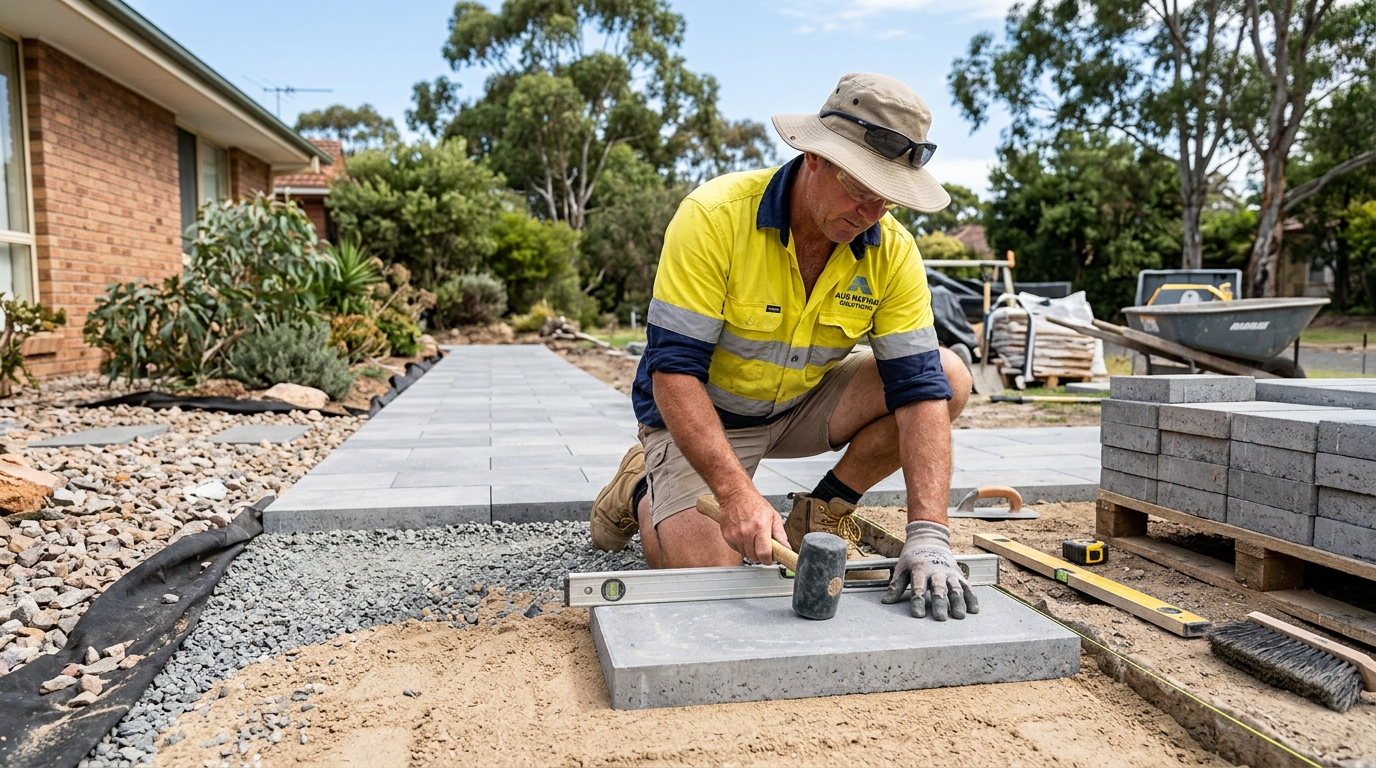
Labour is another major component when you're working out how to quote paving installation. Your time, and your crew's time, needs to be valued correctly. For standard paving, allow between 1.5 to 3 hours per square metre for experienced pavers, including laying and jointing. This can vary based on paver size, pattern complexity, and site conditions. Intricate patterns, small pavers, or difficult access can push this towards the higher end, or even beyond. Demolition and excavation of existing surfaces also add significant labour time – allow 1-2 hours per square metre for removing old concrete or turf and initial levelling. Always factor in travel time to and from the site, as well as time for material pickups. A small crew of two might charge out at $150-$200 per hour, so accurately estimating hours is critical to avoid eating into your profit. If you're doing a complex stone paving pricing job, skilled labour for cutting and fitting custom pieces will increase these figures.
Base Prep & Drainage: Don't Skimp on the Foundation
The foundation of any paving job is the base preparation, and it's where many quotes fall short. A solid base prevents movement, cracking, and drainage issues down the line. First, you'll need to excavate to the correct depth – usually 150-250mm, depending on soil type and expected load. This often involves machinery, adding plant hire costs. Then, a road base (such as DGB20 or similar) needs to be laid, compacted in layers, and screeded. Allow 100-150mm of compacted road base. Material for this can cost around $30-$50 per tonne, and you'll typically need 0.2-0.3 tonnes per square metre. Proper drainage is just as vital. For most outdoor areas, ensuring a 1-2% fall away from structures is standard to prevent water pooling. For larger areas or areas prone to heavy rain, channel drains or subsurface drainage may be necessary, adding hundreds or even thousands to the overall cost. Never cut corners here, as callbacks for failed paving are expensive and bad for your reputation. Consult AS 3727-2016 for guidance on pavements and base design.
Components of a Solid Paving Quote: What to Include
A clear, itemised quote builds trust and avoids disputes. When you sit down to quote paving installation, break it down into logical sections. Start with site preparation: detailing excavation, removal of spoil, and base material supply and compaction. Then list paving materials: paver type, quantity (m2), and unit cost. Labour for laying, cutting, and jointing should be a separate line item, showing estimated hours. Don't forget jointing sand, edge restraints, and any sealing. Clearly list any additional items like drainage systems, steps, or garden edging. Always include GST as a separate line. Use professional quoting software like QuoteMate to streamline this process, quickly adding line items and calculating totals, ensuring your brick paving quote or stone paving pricing is detailed and accurate. A good quote isn't just a price; it's a breakdown of value. Explicitly state what is and isn't included, especially regarding site cleanup and rubbish removal.
Avoiding Common Mistakes and Nailing Your Contingencies
Even the best plans hit snags, especially in paving. One common mistake is not visiting the site. You can't truly quote paving installation without seeing the ground, access, and potential issues firsthand. Another trap is failing to confirm paver availability and current pricing; suppliers can run out, or prices can change overnight. Always get firm quotes from your suppliers. Lastly, skipping a contingency fund is a recipe for disaster. Aim for a 10-15% buffer on your total job cost. This covers unforeseen ground conditions, small material shortages, or a couple of extra hours if the weather turns. It’s better to quote slightly higher and come in on budget than to quote low and hit the client with variations. For a typical 50m2 driveway using mid-range concrete pavers, a contingency might add $500-$750 to a $5000-$7500 quote, ensuring you don't lose money on unexpected issues. Final tip: always confirm the scope of work in writing with your client before starting.
Pro Tips
- Always do a site visit before quoting; photos aren't enough for ground assessment.
- Get current, written quotes from material suppliers – prices change often.
- Factor in machinery hire for excavation and compaction, even for smaller jobs.
- Include a 10-15% contingency for unforeseen issues like bad ground or weather delays.
- Specify paver type, colour, and dimensions in your quote to avoid confusion.
- Don't forget jointing sand, edge restraints, and any necessary sealing in your material list.
- Clearly separate labour, materials, and GST for transparency in your quote.
- Ensure your quote includes site cleanup and rubbish removal, or state if it's excluded.
Quote This Job in Under 2 Minutes
Skip the spreadsheet. QuoteMate’s AI pulls real-time supplier prices and generates a professional PDF quote you can send on the spot.
Or try it on the web →Related Template
Related Trade
More Guides
- Why Tradies Lose $50,000+ a Year to Missed Calls (And How to Stop It)
- AI Receptionists for Australian Tradies: How They Work and What They Cost in 2026
- After-Hours Tradie Calls: How to Capture Every Lead Without Working 24/7
- How to Quote a Staircase Build in Australia
- How to Quote Rendering a House in Australia
- How to Quote a Shower Screen Installation in Australia
- How to Quote LED Downlight Installation in Australia
- How to Price a Kitchen Renovation Accurately for Australian Tradies